
Whether designing a peace education course that is delivered over an extended period of time or a single lesson, I begin by first asking what dimension of “true peace” is to be addressed.
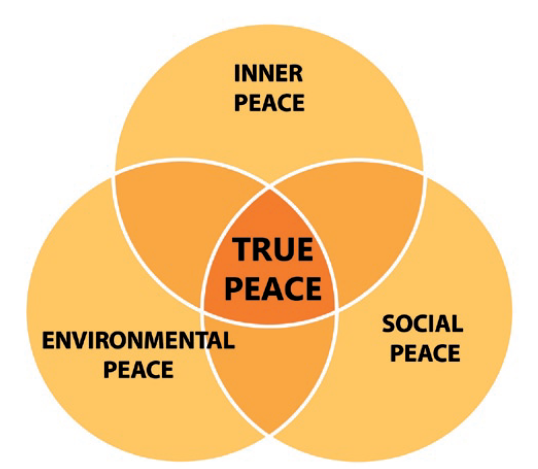
The image that I conceive is three dimensional in nature (no pun intended):
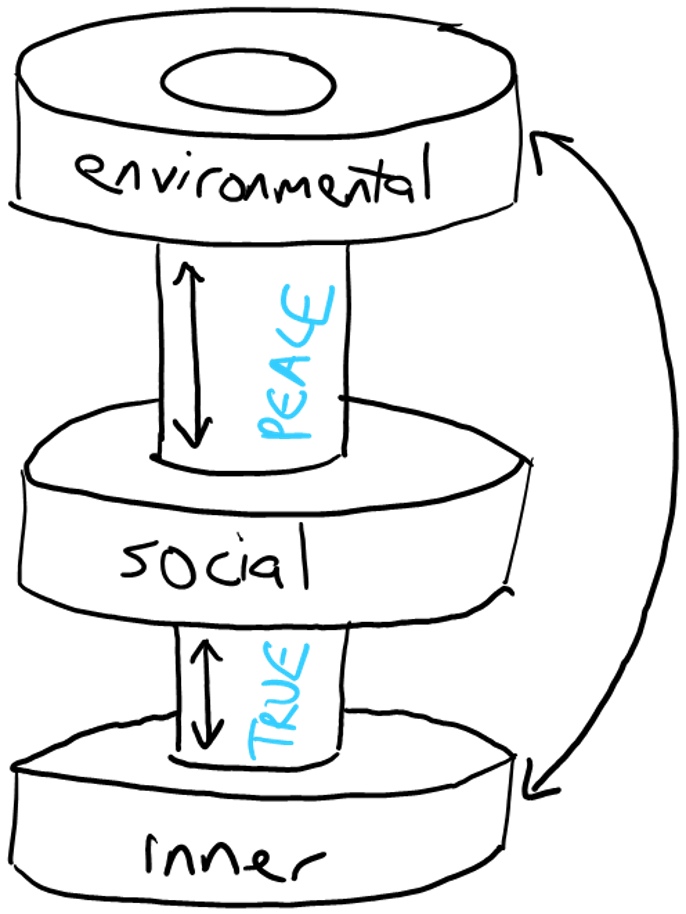
Missing any of the three, there is no true peace. All dimensions are equally important, and the inner dimension is foundational. At the same time, all three are inter-related and inter-dependent. Thus, peace either as process or end goal is a complex endeavour.
In a formal or non-formal learning context, I have found this framework to be particularly useful. What does the school/organization want their learners/participants to engage with? Which of the peace dimensions do we want to focus on? Furthermore, with this framework in mind, I have learnt that my environmental peace dimension knowledge lags far behind the other two. And that my inner dimension lesson designs are very much informed by peace education literature; whereas the ideas from the field of peace studies have much relevance for my sessions on the social dimension of peace.
When designing syllabi and lessons, my approach is multi-disciplinary and goes beyond those fields conventionally associated with peace. For example, my sessions on inner peace have elements from positive psychology as well as social and emotional learning research. And I am currently studying research into spirituality; as I am convinced of its relevance for true peace.
When it comes to the choice of pedagogies and facilitating lessons, the following informs me:

As an educator, I remember and examine my lived experience as a student from primary to PhD schooling. Because of the particular world-views that underlie contemporary formal education systems, the depth of learning is (for the most part) superficial, limited to the school-based level. If the student finds the learning to be life-relevant, then the knowledge and skills acquired are “sticky” i.e. they are retained beyond the examination room1. I posit that peace education must be designed to be transformative in nature.
Transformative learning: “transforms problematic frames of reference to make them more inclusive, discriminating, reflective, open, and emotionally able to change.“2 In other words, I explicitly intend for my peace education learners after sharing space-time with me to leave with knowledge, skills, values and attitudes that encourage them to become more inclusive, discriminating, reflective, open and have the emotional intelligence to navigate the challenging process of transforming their meaning-making schema.
Schooling in much of the contemporary world is intertwined with our human history of labour, production and (more recently) industrialization coupled with market economy. Consequently we have a tendency to value the sum of human learning with an instrumental lens3. When we understand learning to be communicative, and design education to be so, this gives students the opportunity to engage in reflective processes (impossible for learning that is designed and delivered with an instrumental approach)4. Communicative learning creates space for inter-personal and inter-group learning; the beginnings of peace education.
I posit that peace education needs to go even further than that. To effectively educate for peace, the pedagogical choices we make as educators should invite our students to emancipate themselves from inherited structures that have led to the inequalities and inequities in the human world5. In the world of education (learning in the formal space) the phrase “critical thinking” more often than not is meant as the capacity for abstract reasoning. In a session that intends to educate for peace, students/participants must be invited to learn and engage a critical theory lens. Beyond social critique, learners are invited to critically examine their own-selves who are products of their cultural and social milieu. Thus, peace education is not just about emancipating collectives, it is also about freeing the individual to discover their authentic self.
I feel it necessary to point out that I am not dismissing the instrumental type of learning that the most basic peace education course or lesson needs to be. I want to make it clear that effective peace education begins when we view it as communicative learning, and going beyond that, emancipatory learning. In a school setting, I am arguing that effective peace education occurs when we design and deliver lessons and courses that are not constrained by conventional approaches and understandings of learning in the formal space. My subsequent posts will be further elaboration.
Suggested readings:
Carreira, Coulardeau, González, Kalan, Quintilla, Schweitzer, Veeneman, & Villanueva, (2014). Mainstreaming Peace Education – Methodologies, Approaches and Visions: A Practitioner’s Manual. European Intercultural Forum.
Freire, P. (2000). Pedagogy of the Oppressed, 30th Anniversary Edition (M. B. Ramos, Trans.; 30th Anniversary edition). Bloomsbury Academic.
Habermas, J. (1971). Knowledge and Human Interests (J. J. Shapiro, Trans.). Beacon Press.
Illeris, K. (2007). How we learn: Learning and non-learning in school and beyond (English ed). Routledge.
Mezirow, J. (2011). Transformative Learning Theory. In J. Mezirow & E. W. Taylor (Eds.), Transformative Learning in Practice: Insights from Community, Workplace, and Higher Education (1st edition). Jossey-Bass.